If you have one or more missing teeth, it can make chewing food, annunciating words, and smiling difficult.
While most people know that a single missing tooth can be replaced with a single dental implant, did you know that an individual implant can also be used to replace several missing teeth?
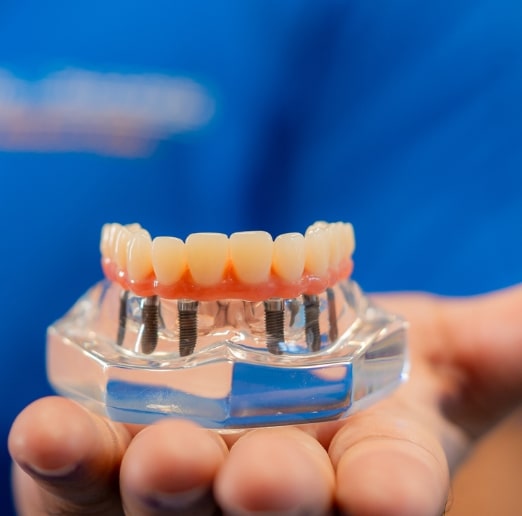
Otherwise known as a multiple-tooth implant or an ‘implant-supported bridge’, it represents a step up from conventional bridges or partial dentures. It is also a cost-effective alternative to replacing every missing tooth with an implant-supported crown. Want to know more about multi-tooth implants? Read on for a more defined explanation.
The Benefits Of Multiple-Tooth Implants
Here are 4 solid reasons why you might want to choose multi-tooth implants over other tooth replacement options:
- They offer increased strength and durability that conventional bridges simply cannot provide.
- They preserve surrounding teeth, unlike traditional bridges that often require modifications to support natural teeth. These are modifications that can compromise the health of a tooth.
- They represent a long-term solution that can last for many years.
- Multi-tooth implants are a cost-effective alternative to individual implants when you have multiple missing teeth.

What To Expect At Smile Success
At our Camberley practice, we’ve been supporting the people of Surrey with implant-based restorations for many years. So here’s what you can expect when you book an implant consultation.
During your first visit, we’ll carry out a thorough dental examination to see if you’re eligible and talk you through your options and payment plans. We’re also happy to answer all your questions and concerns so you have all the tools necessary to make a fully informed decision.
If you decide to go ahead, we’ll take some pictures of your jaw using 3D imaging software during a second consultation. From this, we’ll develop a personalised treatment plan detailing the process, the length of time it will take and the costs involved.
Once you’ve read through everything and are happy, we’ll get you to sign a consent form, and our implant coordinator will book you in for your implant treatment.
The surgical aspect will only take 1-2 hours, after which you may be fitted with temporary restorations.
After several months and once the implant has fully stabilised in the jaw, any temporary restorations are removed and your permanent bridging restorations are fitted.
Don’t Suffer The Consequences Of Multiple Missing Teeth
Get in touch with the professional team at Smile Success and ask us about multiple-tooth dental implants.
FAQs
1. How Does A Multiple Tooth Implant Work?
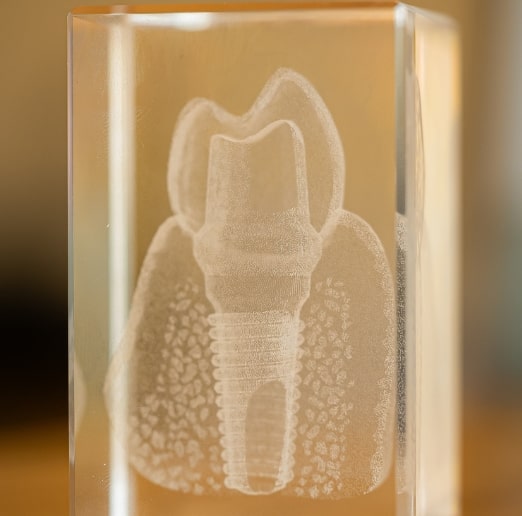
Similar to a conventional bridge, a multi-tooth implant relies on a pontic ‘bridging’ restoration to span the gap.
However, unlike a traditional bridge where the pontic tooth is anchored by a metal framework and supporting crowns that sit over adjacent natural teeth, the bridging tooth of an implant-supported version is attached to a single dental implant.
The implant creates a fully stable, standalone structure that supports the bridging restoration and doesn’t rely on adjacent teeth. Here are some examples of how we might use a multiple-tooth dental implant:
- For two adjacent missing teeth, you might have a multi-tooth implant, which is anchored into the first gap, coupled with a cantilevered ‘bridging’ tooth covering the second.
- Alternatively, if you have 3-5 adjacent missing teeth, we might suggest a multiple-tooth implant at either end of the gap with a bridging tooth or teeth spanning the middle.
- Finally, 5-6 missing teeth may use just 3 multiple-tooth implants with corresponding bridging teeth spanning the remaining gaps.
As you can see, multi-tooth implants are an adaptable and cost-effective solution that fits most eventualities.
back to Dental Implants





 Free Dental Implant Consultations